What is Judo? An introduction for families
What is Judo?
Judo is a Japanese martial art and Olympic sport founded by Jigoro Kano in 1882. The word judo translates to “the gentle way” — a name that reflects its emphasis on using technique and leverage rather than brute force. Practitioners (called judoka) learn to throw opponents to the ground, control them with pins and holds, and fall safely using breakfalls. There is no punching, kicking, or striking in judo.
Judo has been an Olympic sport since 1964 (men’s) and 1992 (women’s), and is practised in over 200 countries. It is one of the most widely practised martial arts in the world, with an estimated 50 million practitioners globally.
The core techniques
Judo techniques are divided into three main categories:
Throws (nage-waza)
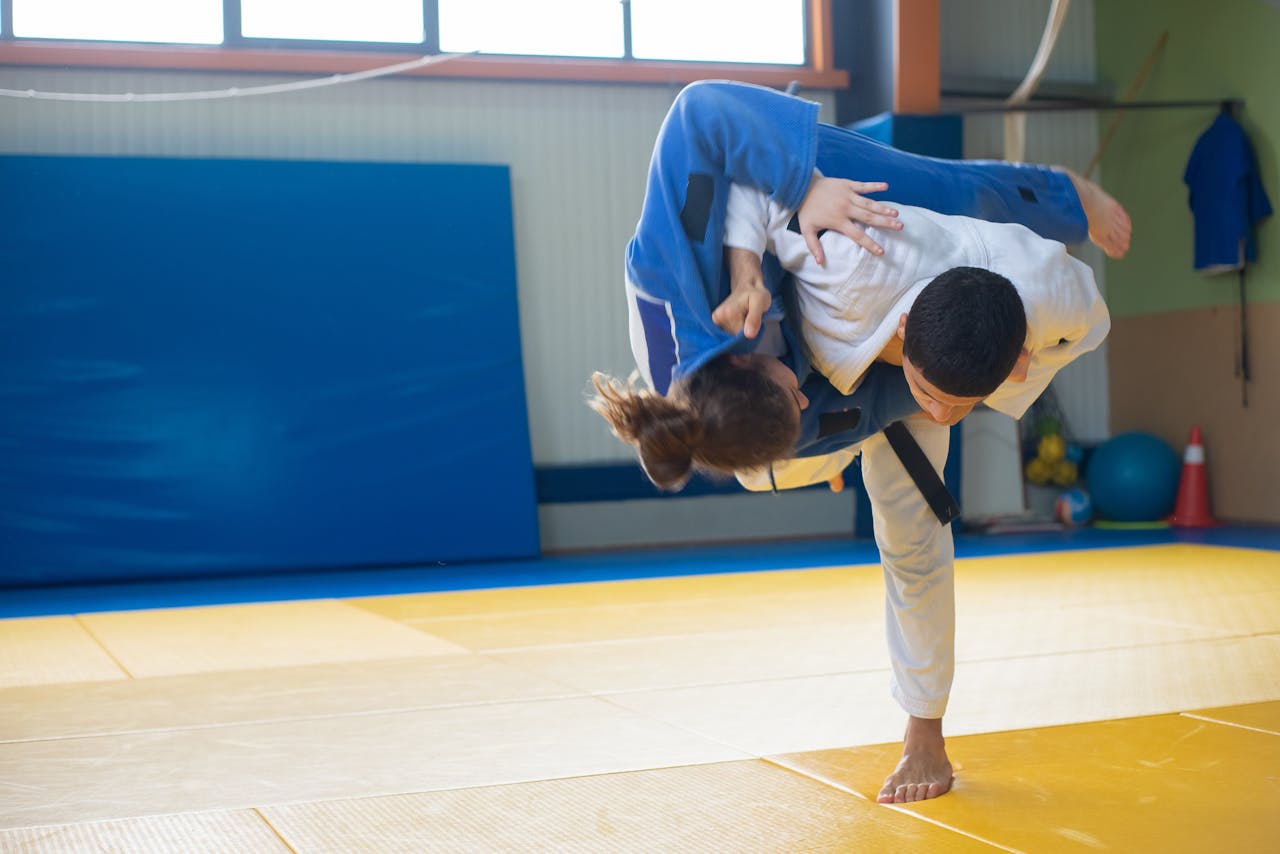
Judo is best known for its spectacular throwing techniques. A judoka uses grip, balance, and timing to lift or sweep an opponent off their feet and onto the mat. There are 67 officially recognized throwing techniques in the Kodokan judo syllabus, ranging from hip throws and shoulder throws to foot sweeps and sacrifice techniques.
Key throws that beginners learn include o-soto-gari (major outer reap), o-goshi (major hip throw), and seoi-nage (shoulder throw).
Groundwork (ne-waza)
Once on the ground, judo continues with pins (osaekomi-waza), chokes (shime-waza), and joint locks (kansetsu-waza). In children’s judo, only pins are used — chokes and joint locks are introduced at higher levels and older ages. Groundwork in judo involves controlling an opponent’s position and movement, similar to wrestling and Brazilian jiu-jitsu.
Breakfalls (ukemi)
Breakfalls are the first and most important skill in judo. Before learning any throw, every judoka learns how to fall safely — backward, sideways, and forward. Proper breakfall technique distributes the force of a fall across a wide area of the body, protecting the head, neck, and joints. This is a genuine life skill that protects people in falls during daily life, not just on the judo mat.
The founding principles
Jigoro Kano built judo on two core principles that still guide the art today:
Jita kyoei — mutual welfare and benefit
Judo is fundamentally cooperative. Training partners work with each other to improve. When one person practises a throw, the other person practises a breakfall — both benefit. This principle extends beyond the mat: judoka are expected to contribute positively to their community.
Seiryoku zenyo — maximum efficiency with minimum effort
Judo techniques are designed to achieve the greatest effect with the least expenditure of energy. A smaller person can throw a larger one by using superior technique, timing, and leverage. This principle makes judo accessible to people of all sizes and is part of why judo’s techniques are so effective in real-world situations.
The belt ranking system
Judo uses a coloured belt system to mark progress. While the exact colours vary by country, the typical progression in Canada is:
- White belt — beginner
- Yellow belt — first grading
- Orange belt
- Green belt
- Blue belt
- Brown belt
- Black belt (shodan — 1st degree through judan — 10th degree)
Grading involves demonstrating techniques, knowledge of judo principles, and (at higher levels) competition results. It’s a structured path of development that gives students clear goals to work toward.
How Judo differs from other grappling arts
Judo vs. Brazilian jiu-jitsu (BJJ): BJJ evolved from judo in the early 20th century when Mitsuyo Maeda, a judoka, taught the Gracie family in Brazil. BJJ focuses almost entirely on ground techniques (submissions and positional control), while judo emphasizes standing throws with groundwork as a complement. Judo is an Olympic sport; BJJ is not (as of 2026).
Judo vs. wrestling: Both are Olympic grappling sports that involve takedowns and ground control. Wrestling uses different grips (no gi/uniform), has different rules about ground engagement, and includes styles like freestyle and Greco-Roman. Judo’s throwing techniques are generally more diverse, while wrestling emphasizes single-leg and double-leg takedowns not found in judo.
Judo vs. karate: Karate is a striking art (punches, kicks, blocks); judo is a grappling art (throws, pins, holds). They are complementary rather than competing — many martial artists train in both.
Judo in Guelph
Kohbukan Judo Club has taught judo in Guelph, Ontario since 1974. It is Guelph’s only judo club and is affiliated with Judo Ontario and Judo Canada. The club offers programs for children (ages 6–14), youth (14–17), and adults (18+), with classes on Monday and Wednesday evenings at 10 Speedvale Ave E.
Kohbukan is a member-run nonprofit founded on the same principles Jigoro Kano established — mutual welfare and benefit for all members. New students of any age or experience level are welcome. Your first week is free.