Judo vs. BJJ: What's the difference?
How are Judo and BJJ related?
Judo and Brazilian jiu-jitsu (BJJ) are closely related grappling arts with a shared history. BJJ evolved directly from judo in the early 20th century when Mitsuyo Maeda, a Japanese judoka, emigrated to Brazil and taught the Gracie family. The Gracies adapted what they learned — emphasizing ground fighting and submissions — and over decades developed it into a distinct martial art.
Today the two arts look quite different in practice, but they share a common technical foundation and many of the same principles.
The key differences
Where the action happens
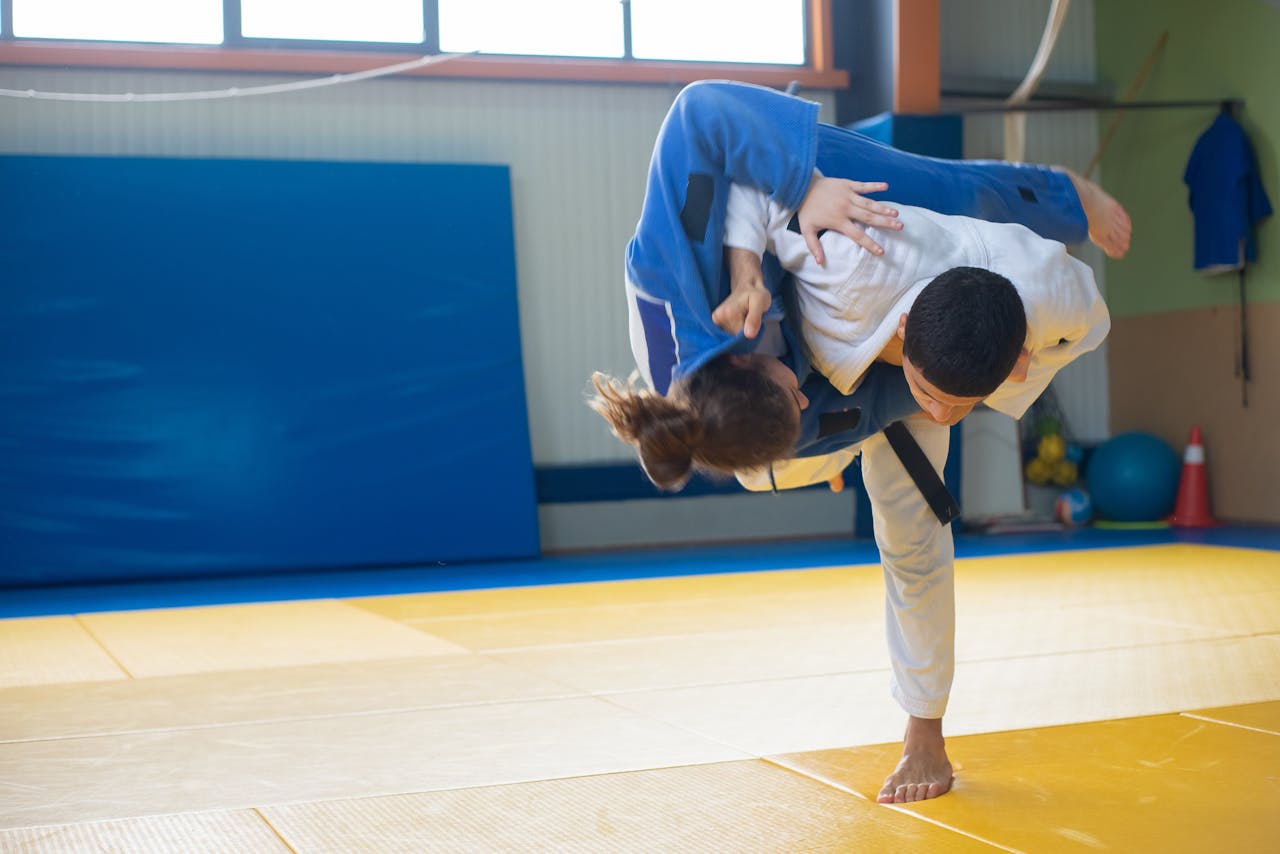
The most visible difference is emphasis. Judo focuses primarily on standing technique — using throws, trips, and sweeps to take an opponent from their feet to the ground. Groundwork (ne-waza) is part of judo, but the standing phase is where most of the action takes place in both training and competition.
BJJ is the opposite. While BJJ includes takedowns, the majority of training and competition happens on the ground. Practitioners work to achieve dominant positions and apply submissions — joint locks and chokes — from the ground.
Rules and competition
In judo competition (governed by the International Judo Federation), a clean throw that lands an opponent on their back can win the match instantly (ippon). Ground fighting is allowed but time-limited — if neither player is actively progressing on the ground, the referee will stand them back up. Strikes are not permitted. Judo has been an Olympic sport since 1964.
In BJJ competition (governed by the IBJJF and other organizations), matches are primarily scored on positional control and submissions. There is no time limit on groundwork — matches can spend the entire duration on the ground. Points are awarded for sweeps, passes, and achieving dominant positions. BJJ is not currently an Olympic sport.
The uniform
Judo is practised in a heavy cotton uniform called a judogi (or simply “gi”), which is designed to withstand the grip-intensive nature of judo throws. Gripping the gi is a fundamental part of judo technique.
BJJ is practised in both gi and no-gi formats. The BJJ gi is similar to a judogi but often lighter. No-gi BJJ uses a rash guard and shorts, and the absence of a gi changes the grappling dynamics significantly — without a collar or sleeve to grip, different control techniques are needed.
Training approach
A typical judo class includes warmups, breakfall practice (ukemi), standing technique drills, groundwork, and randori (live sparring from standing). Breakfalls are taught from the very first class — learning to fall safely is the foundation of all judo training.
A typical BJJ class includes warmups, positional drilling (often starting from the ground), technique instruction focused on guard work, passes, and submissions, and rolling (live sparring, usually starting seated or on the knees).
What they share
Despite their differences, judo and BJJ have significant overlap:
- Grappling fundamentals — grip fighting, balance, leverage, and body mechanics are central to both
- Ground techniques — many pins, chokes, and joint locks exist in both arts, though the names and emphasis differ
- No striking — neither art involves punching or kicking
- Belt ranking — both use coloured belt systems to mark progression, with black belt as the standard of expertise
- Partner-based practice — both require a training partner and emphasize mutual respect and safety
- Self-defence value — both teach practical skills for controlling a physical confrontation without striking
Which is better for self-defence?
Both arts are effective for self-defence, but they address different scenarios:
Judo’s strengths: Judo teaches you to stay on your feet, control distance, and take someone to the ground decisively if needed. Breakfall training protects you in any fall — not just in martial arts. In a real-world confrontation, the ability to throw someone and remain standing is a significant advantage.
BJJ’s strengths: BJJ excels when a confrontation goes to the ground. Its deep catalogue of submissions and positional control gives practitioners options from any ground position, including from their back (using the guard).
Training in both gives you tools for standing and ground situations, since real confrontations are unpredictable.
Which is right for you?
You might prefer judo if you:
- Want a dynamic, full-body workout with an emphasis on throws
- Value breakfall training as a practical life skill
- Are interested in an Olympic sport with a long competitive tradition
- Prefer training in a gi
- Want a martial art with deep cultural traditions and philosophy
You might prefer BJJ if you:
- Are drawn to the puzzle-solving aspect of ground fighting
- Want to train both gi and no-gi
- Prefer a ground-focused approach to grappling
- Are interested in the growing competitive BJJ scene
Consider both if you: want a complete grappling skill set. Many serious grapplers cross-train in both arts, and the skills complement each other well. Strong judo gives a BJJ player better takedowns; strong BJJ gives a judoka more options on the ground.
Judo in Guelph
Kohbukan Judo Club has taught judo in Guelph, Ontario since 1974. Programs are available for children (ages 6–14), youth (14–17), and adults (18+), with classes on Monday and Wednesday evenings at 10 Speedvale Ave E. All instructors are NCCP-certified with decades of experience.
Whether you’re coming from BJJ, another martial art, or no martial arts background at all, you’re welcome. Your first week is free.