Judo for children: Benefits beyond the mat
What does Judo do for children?
Judo develops confidence, physical fitness, discipline, and resilience in children through structured, partner-based practice. Because judo is a contact sport with no striking, children learn to manage physical situations calmly and respectfully — skills that transfer directly to everyday life. Judo parents consistently observe that their children show improved self-regulation, social skills, and physical development.
Physical development
Full-body fitness
Judo is one of the most physically demanding activities a child can do. A typical class includes warmup exercises, breakfall practice, technique drills, and (for more experienced students) randori — live practice. This combination develops:
- Strength — gripping the gi (uniform), executing throws, and resisting pins builds functional, whole-body strength
- Coordination — judo techniques require precise timing and body positioning
- Balance — every throw involves disrupting an opponent’s balance while maintaining your own
- Flexibility — ground techniques and throwing mechanics develop natural range of motion
- Cardiovascular fitness — judo training alternates between high-intensity bursts and technical work
Unlike sports that develop one type of fitness (running for cardio, gymnastics for flexibility), judo develops all of these simultaneously.
Breakfalls: a life skill
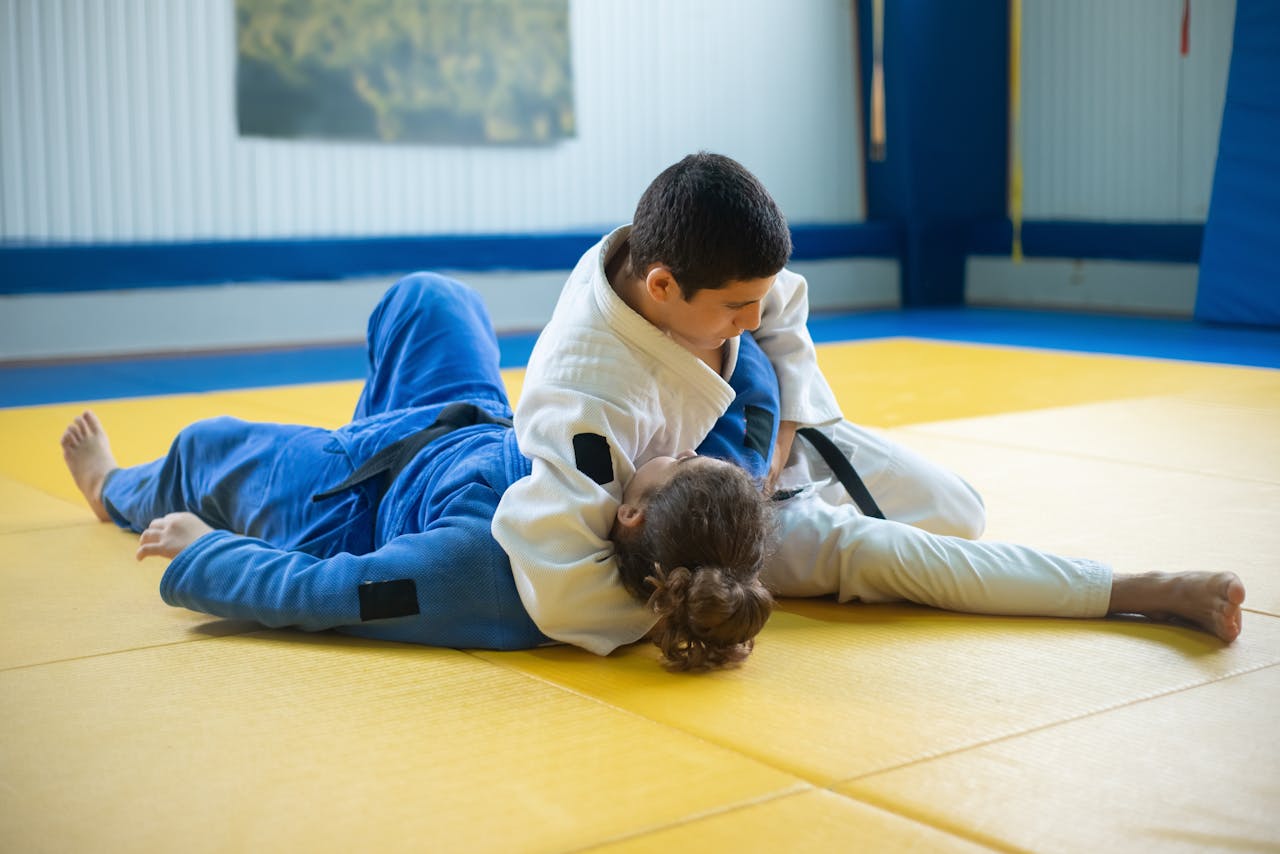
The first and most important skill children learn in judo is ukemi — how to fall safely. Breakfall training teaches children to land without injury by distributing the force of a fall, protecting their head, and rolling with momentum.
This isn’t just a judo skill. Children who know how to fall safely are better protected during:
- Playground falls
- Cycling and skateboarding accidents
- Slips on ice or wet surfaces
- Collisions during other sports
According to the Public Health Agency of Canada, falls are the leading cause of injury-related emergency department visits among Canadian children, accounting for an estimated 187,000 ED visits per year. Breakfall training directly addresses this risk.
Confidence and self-esteem
Judo builds confidence through mastery, not aggression. Children earn each new skill through practice and effort. When a child successfully executes a throw on a resisting partner for the first time, that achievement is real — and they know it.
The belt system reinforces this with visible milestones. Progressing from white belt through yellow, orange, green, and beyond gives children concrete goals and a sense of accomplishment. But the deeper confidence comes from knowing they can handle physical situations — that they can fall without getting hurt, maintain composure under pressure, and control their body.
This is not the false confidence of being told “you’re special.” It’s the earned confidence of having done something difficult, repeatedly, and gotten better at it.
Discipline and focus
Every judo class follows a structure: bow in, warmup, instruction, practice, bow out. Children learn to listen to instructions, wait their turn, and focus on the task in front of them. The dojo environment reinforces this with clear expectations about behaviour, respect for training partners, and care for the shared training space.
Judo’s partner-based practice is especially valuable for discipline because the consequences of carelessness are immediate and visible. If you don’t pay attention to your partner’s safety, someone gets hurt. Children internalize this responsibility quickly — it’s discipline motivated by care for others, not by punishment.
Anti-bullying resilience
Judo gives children tools to handle bullying without becoming aggressors themselves. This works on multiple levels:
Physical confidence
Children who practise judo know they can handle a physical confrontation if they must. This knowledge alone changes how they carry themselves — bullies tend to target children who appear vulnerable, and children who move with confidence are less likely to be targeted.
De-escalation over aggression
Judo teaches control, not violence. A child who knows judo can break a grip, maintain their balance, or take someone to the ground and pin them — all without throwing a punch. This gives children options besides fighting back or running away.
Emotional regulation
The experience of being thrown, pinned, and challenged in practice — and getting up to try again — builds emotional resilience. Children learn that setbacks are temporary, that discomfort passes, and that persistence leads to improvement. These lessons apply directly to social stress, academic challenges, and emotional situations.
Social skills and mutual respect
Because judo is entirely partner-based, children develop social skills as a natural part of training:
- Trust — allowing a partner to throw you requires trust; being trusted with someone else’s safety builds responsibility
- Communication — effective practice requires paying attention to a partner’s signals and adjusting intensity
- Empathy — judo’s founding principle of jita kyoei (mutual welfare and benefit) means every interaction on the mat should leave both partners better off
- Diverse friendships — children train with partners of different ages, sizes, and skill levels, building comfort with diversity
What parents say
Parents at Kohbukan Judo Club in Guelph have shared their experience:
“My young son just got his yellow belt. The instructors are top notch and great with kids. It is a fun, family friendly atmosphere that has exceeded my expectations.” — Sam S.
“For those who’ve never tried Judo, do yourself a favor and check out Kohbukan. They’re a friendly and inviting club with a good mix of people. Whether you’re a beginner or an experienced Judoka, you’ll learn, develop new skills, and feel stronger both mentally and physically.” — Lyle S.
Children’s Judo at Kohbukan in Guelph
Kohbukan Judo Club offers children’s judo for ages 6–14 on Monday and Wednesday evenings (6:00–7:15 PM) at 10 Speedvale Ave E in Guelph, Ontario. The club has been teaching judo in Guelph since 1974 and is affiliated with Judo Ontario and Judo Canada.
Instructors are NCCP-certified with decades of experience teaching children. Classes are structured to be safe, engaging, and progressive — new students start with breakfalls and build from there.
Financial assistance is available through KidSport Canada, Canadian Tire Jumpstart, and The Children’s Foundation Free to Grow Program for families who need support.
Your first week is free. Sign up for a trial — parents are welcome to watch every class.